Early Life (p2)
 Left-Brain
Curiosity
Early in my life I developed a real curiosity about how things worked. I loved to take things apart to see what made them tick. (Later in life I would graduate to putting them back together, but for now I just wanted to see what was on the inside.)
And that early curiosity manifested itself into a trouble-shooting thought process that would stick with me for the rest of my life.
I remember my folks getting ready to throw out a dead toaster once, and I asked if I could take a look at it. Sure, humor the kid.
When I opened it up, I didn't really understand what I was looking at. But I did see where the coil of wire that usually glowed red when toasting, was broken off and hanging loose on one end.
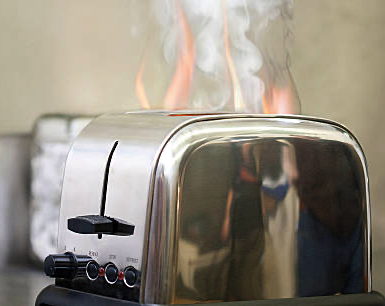
So I glued the it back together with some white Elmer's glue and, interestingly enough, it worked. For all of about 90 seconds before the smell of burning glue got so bad my dad unplugged it and returned it the garbage can.
But, for me, that was a big win. And a shot in the arm to keep it up.
I learned that if you could figure out how something was supposed to work, then that was half the battle of getting it fixed. (If only I'd known about solder!)
Early Experiments
As far back as I can remember, I've always been fascinated by electricity (It could've started with that toaster).
What a mysterious thing that was. What was it? And where did it come from? How do you make it? How do you make it do stuff?
So very early on, I started doing my own scientific experiments to help me get my head around it.
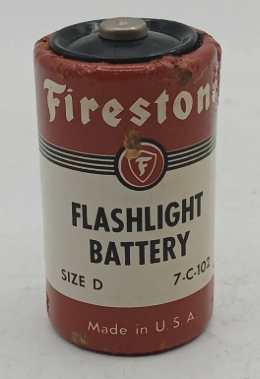
A couple early questions I had about electricity were, "How does it get into a battery? And can you put more in after it's used up?"
So, the logical experiment for me was to see if I could get the electricity back into the battery after it was dead.
I Scotch taped the braided ends of the AC power cord (previously rescued from the dead toaster) to both ends of a dead D-cell battery. My logic was that there was plenty of electricity in the wall outlet. It seemed unlimited. So why not take some of it and put it back into the battery? Makes sense, right?
Again, good idea -- but not-so-great an implementation. (What do they say about learning from your failures?
Turns out there were several problems with the basic hypothesis, not the least of which was the very real possibility of severe bodily harm or death.
There was also--unknown to me at the time--a very large difference in voltage to contend with. Combined with the fact that one source (the wall outlet) was alternating current and the other one was direct current. (Those 2 don't really mix well together.)
But none of that really mattered after the battery basically exploded, leaving the melted Scotch tape seared to the battery's two remaining metal plates.
My philosophy back then: "Wow, that was cool." (and that became a recurring theme moving forward)
Right-Brain
Dad's Trumpet
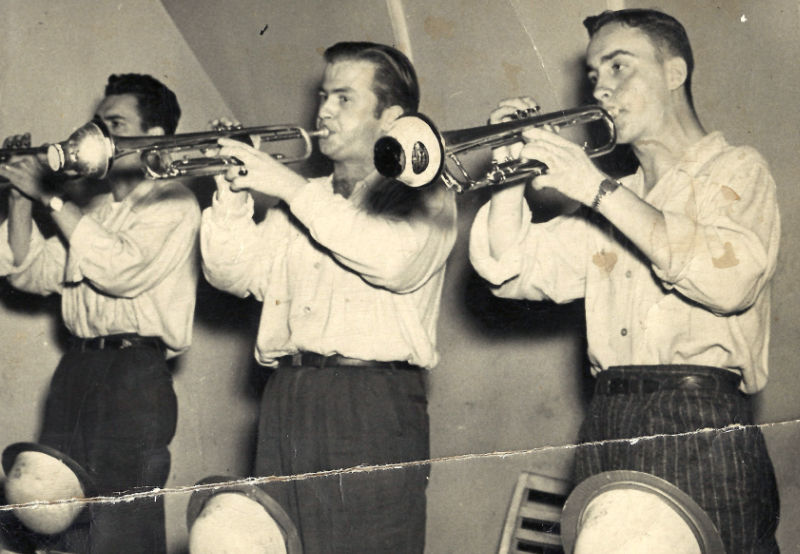
My dad played trumpet professionally in a couple different Big Band dance bands (Guy DeLeo - Lynn Kerns) before he got married. So, I guess in some respects it was inevitable that he would "encourage" his kids to follow in his footsteps. (He's the hansom devil on the far right.)
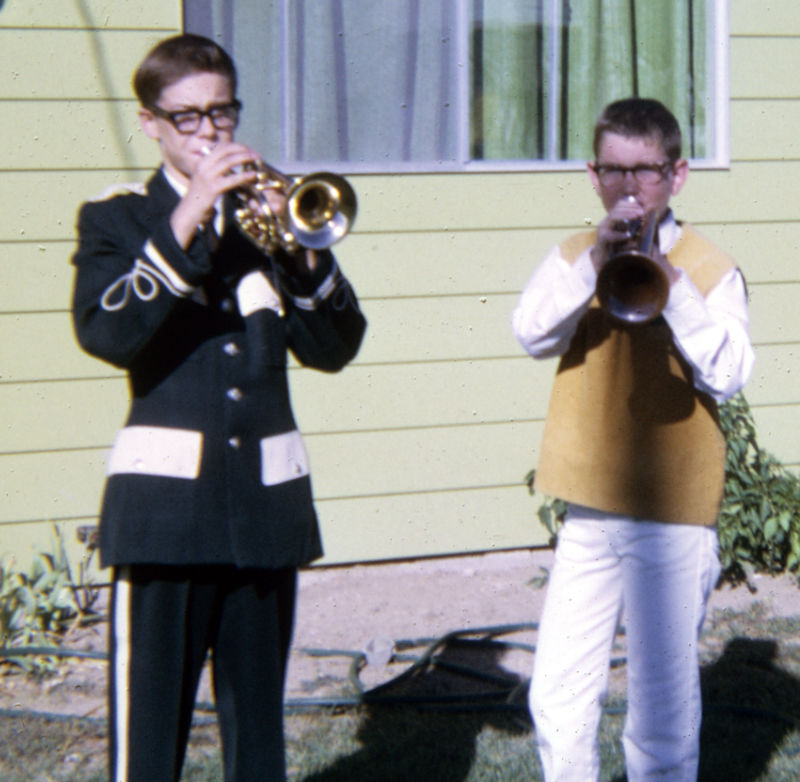
So, in 4th grade, I picked up my first coronet and took the first baby steps into the future that was waiting for me. Later on at one time or another, most of my siblings gave the horn a shot - but with me, it just seemed to stick.
Sticking With It
I played horn all through grade school, junior high, and high school (at least that's how they referred to schools back then). Somewhere along the line I switched from coronet to a full-blown trumpet.
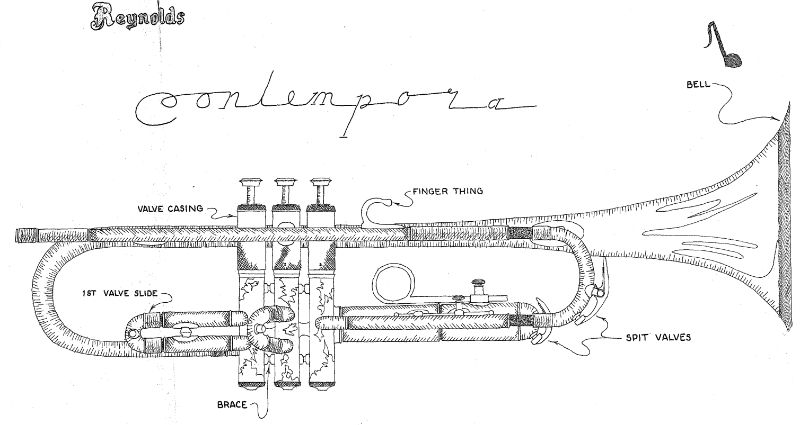
It was the one my dad played for all those years so it was kind of like a connection to him through the music. (we had a rocky road connecting a most anything when I was growing up)