A Seismograph Primer
seis·mo·graph
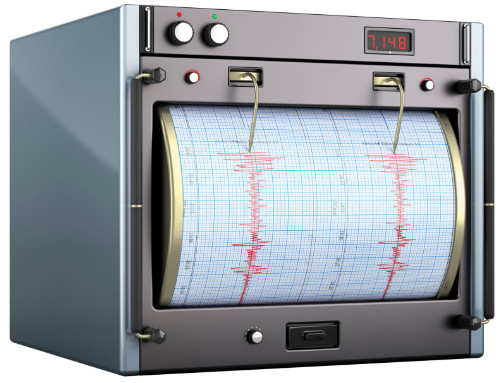
noun: an instrument that measures and records details of earthquakes, such as force and duration.
In A Nutshell
Basically a seismograph crew's job is to do a seismic survey of an area that a client (an oil company) has determined has a reasonable suspicion of containing oil.
The survey consists of generating a sound or vibration strong enough to resonate through the earth's surface, down several hundred feet, and then record the sound waves that are returned as they bounce back off of the different layers of material underground.
These recordings help Geologists determine the probability of finding oil in the survey area.
Types of Crews
There are basically 3 kinds of seismograph crews:
- Truck
- Portable
- Marine
Common to All Crews
All 3 types are going to have these things in common:
- a sound source
- a long cable with sensors for receiving the returned sound waves (the "Line")
- someway of knowing where to put the line
- a way to record those sound waves
- all the needed personnel to keep the operation running smoothly
Truck Crews
Truck Crews operate anywhere the terrain allows for driving trucks (dah).
They use a large vibrating plate attached to the bottom of a truck (imagine that). The plate can be lowered to come in contact with the ground and then vibrate to generate the sound needed to penetrate the ground.
A Truck Crew has a line of cable laid on the ground for several miles. At periodic intervals, transducers known as "jugs" are stomped into the ground by the Front Crew and connected to the line that feeds back to the truck that houses the recording equipment.
Conversely, the Back Crew, positioned at the end of the line, will pick up the cable and jugs after each "shot" (the recorded vibration) and periodically shuttle them up to the Front Crew so they can lay then out along the predetermined path set by the Survey Crew.
A limitation of a Truck Crew is that the terrain has to allow for driving (dah).
Portable Crews
Note: this is the type of crew that I was on (at least most of the time).
A Portable Crew operates where wheeled vehicles cannot: basically in the mountains.
Portable Crews use the same several mile long line of cable and connected jugs as a Truck Crew, but instead of trucks, they use helicopters to move people and gear around.
And, instead of a vibrating plate for the sound source, they use dynamite. (How cool is that?)
Marine Crews
Pretty much what you'd expect. A Marine Crew operates on water out of large boats. The sound source comes from a floating buoy that vibrates similar to the plate on the Truck Crew.
The multi-mile long cable and its transducers are pulled behind the boat.
Lifestyle
Both Portable and Truck Crews have a pretty nomadic, gypsy-like lifestyle.
Living in seedy motel rooms. Frequently moving. Hopping from state to state following the work.
Because of the high cost of these seismic surveys, the workload is heavy. The crew shows up before light and works until right before dark (helicopter flying hours), 7 days a week. Rain or shine. Thanksgiving and Christmas.
Be On Time
On the Portable Crew that I was the field supervisor for, we had a sign in sheet on a clipboard in the office. Each morning at 5:00 AM, the sheet came down. If your name was on that sheet, then you'd get your $25 a day per diem for that day (which you could get by on pretty well in the early eighties). If you missed sign up -- then no $25 bucks for that day!
This was such a good early lesson in responsibility for me. I don't know how many times I saw people miss sign up. Not because they weren't there, but because they were still in line when the sheet came down.
"Get here earlier tomorrow," the boss would say coldly.
And this policy wasn't just some punitive directive from an overbearing tyrant. It was based on simple arithmetic. The whole operation had a ridiculous amount of overhead per day -- by the time you added up the crew, all the support personnel, a couple helicopters, all the fuel and maintenance -- it was staggering!
So, every minute we were not generating billable survey data for the client, was a minute that cost the company hundreds of dollars.
As a side note, I never missed a single day of per diem (ever!).